What is ACL Revision?
ACL revision is a second surgery to rebuild the anterior cruciate ligament after a first reconstruction has failed.
ACL stands for the anterior cruciate ligament, a key stabilizing band in the knee. When a rebuilt ACL tears again or does not hold, revision surgery replaces the graft. It is more complex than a first-time reconstruction and calls for careful planning.
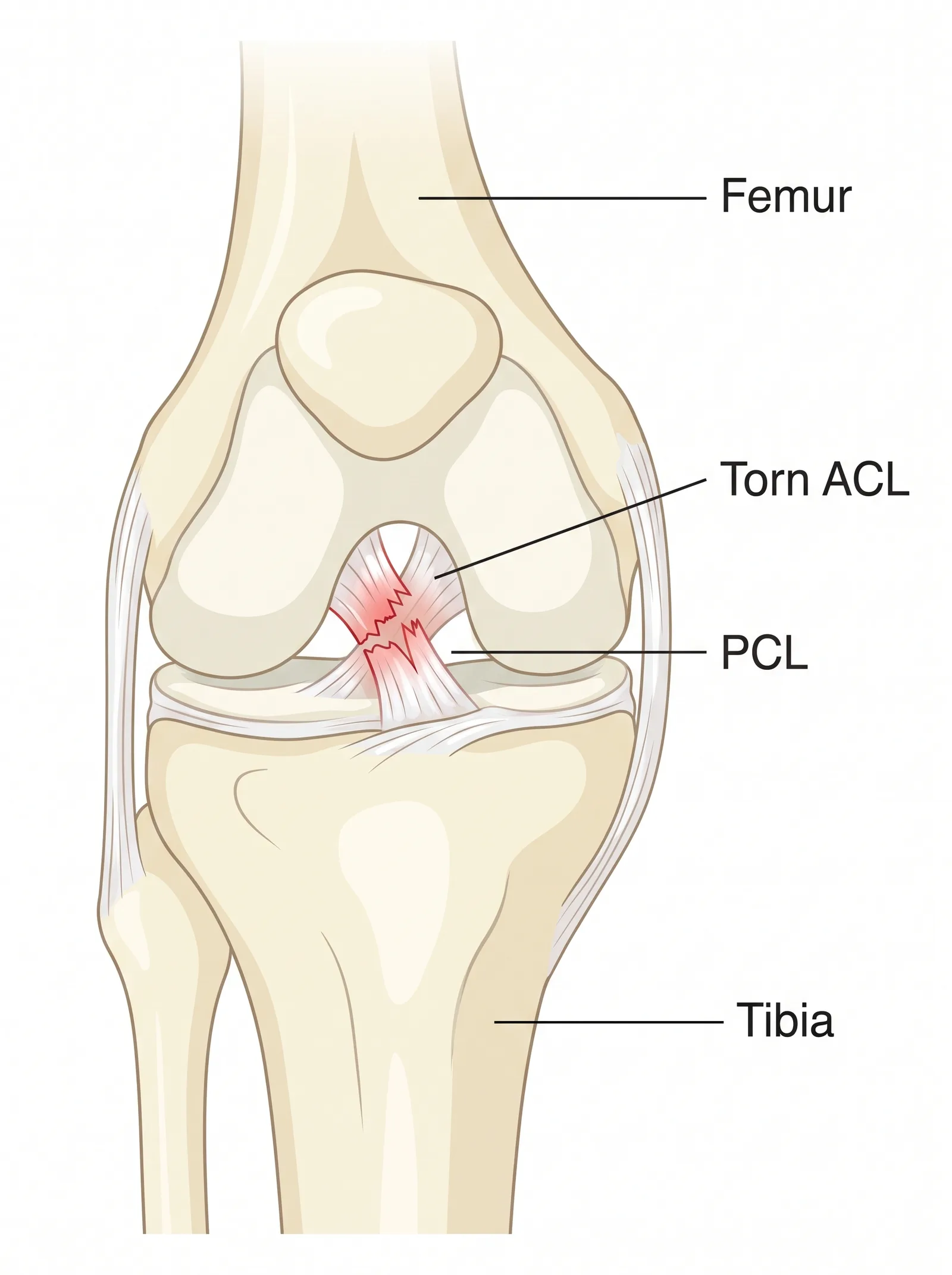
The anterior cruciate ligament, or ACL, is one of the strong bands in the center of the knee that keeps it stable, especially during pivoting and cutting. When it tears, it is often rebuilt with a graft, which is a piece of tendon used in place of the ligament. That first surgery is called ACL reconstruction.
Most reconstructions do well, but some fail. A graft can retear from a new injury, or it can loosen or fail to heal well. Sometimes the way the first graft was positioned, or other factors such as the shape or alignment of the knee, contributed to the failure. When a rebuilt ACL fails and the knee is unstable again, a second surgery, called ACL revision, can rebuild it. Revision is more involved than the first surgery because the surgeon must work around old tunnels and hardware in the bone and understand why the first graft failed, so the same problem is not repeated.
What are the symptoms of ACL Revision, and when should you see a specialist?
People who consider revision usually had an ACL reconstruction in the past and now feel instability again.
You may notice some of these.
- A feeling that the knee gives way or shifts during pivoting, cutting, or turning. - Swelling after activity. - A sense that the knee is not trustworthy, so you avoid certain movements. - A new injury that made a previously stable knee feel loose again. - Trouble returning to the activities you managed before the first surgery.
It is worth seeing a specialist if a knee that had an ACL reconstruction becomes unstable again, whether after a new injury or gradually. An evaluation sorts out whether the graft has failed, why, and what would need to be corrected in a revision. Because the reasons for failure guide the plan, this evaluation is detailed.
This page explains revision surgery and who may need it. It does not tell you what is happening in your own knee. Only an in-person evaluation can do that.
How is ACL Revision diagnosed, and what does the visit involve?
The visit begins with the full story of your first surgery and what has happened since: how the knee felt after the first reconstruction, whether a new injury occurred, and when the instability returned.
This history helps explain why the first graft failed.
The physical exam checks the knee's stability and compares it with the healthy side, along with motion and alignment. The surgeon looks for other issues that could have contributed to failure, such as looseness in other ligaments.
Imaging is especially important in revision. X-rays and often a CT scan, a detailed scan that shows bone in cross sections, show the old tunnels and any hardware from the first surgery. Knowing the exact position and size of those tunnels shapes the revision plan. An MRI, a scan that shows soft tissue, shows the failed graft and the state of the cartilage and meniscus. This careful imaging is what makes a revision different from a first-time surgery, because the surgeon plans around what is already there.
What happens during ACL Revision, step by step?
ACL revision replaces the failed graft while accounting for the previous surgery.
The sequence below is typical, though revisions are individualized.
Anesthesia. Surgery is usually done under general anesthesia, meaning you are fully asleep, often with a nerve block for pain afterward. Your anesthesia team reviews the plan.
Dealing with old tunnels and hardware. The surgeon addresses the tunnels and any screws or anchors from the first surgery. Sometimes old hardware is removed. If the old tunnels are too wide or poorly placed to reuse, they may be filled with bone graft. In some cases this is done as a first stage, with the new ligament rebuilt at a later operation once the bone has healed. Your surgeon will tell you if a two-stage plan is likely.
The new graft. A new graft is chosen, often from a different source than the first one, such as another of your own tendons or donor tissue, called allograft. The choice depends on what was used before and the state of your tissue.
Arthroscopy and placement. Using an arthroscope, a small camera placed through tiny incisions, the surgeon creates or reuses tunnels in the correct positions and secures the new graft, then sets the tension so the knee is stable and can still move. Correct tunnel position is a key focus, since poor position can cause failure.
Added corrections. If the evaluation found other factors, such as looseness elsewhere or alignment issues, those may be addressed to protect the new graft. The surgeon confirms stability before closing.
What is the recovery timeline for ACL Revision?
Revision recovery is often more cautious than first-time ACL recovery, and progress is measured by what your knee can do.
The ranges below are typical.
Milestone one, protect the new graft. Early on, the goal is to control swelling, protect the graft, and begin regaining motion. A brace and crutches are common at first. You reach this milestone when you can straighten the knee fully and bend it to the range your therapist sets.
Milestone two, walk without aids. Once you control the knee and walk without a limp, crutches are usually left behind.
Milestone three, rebuild strength. Therapy then focuses on thigh and hip strength. You reach this milestone when your surgical leg approaches the strength of the other leg on your therapist's tests.
Milestone four, return to activity. Return to cutting and pivoting sports depends on strength, control, and confidence, and passing your team's tests, not on a date. After a revision, return to demanding sport is often approached more cautiously than after a first surgery.
According to general guidance from the American Academy of Orthopaedic Surgeons, recovery from ACL reconstruction commonly spans several months to about a year before return to demanding sports, and revision recoveries can take longer. These are ranges, not promises. Your timeline depends on whether the surgery was one or two stages, other corrections, your health, and your rehabilitation.
Read the full guide to preparing for surgery →
Your own recovery instructions come from the office and are specific to you. This page describes the general course, not a plan to follow.
How should you prepare for surgery?
Planning ahead makes the early weeks easier, and revision may involve extra steps.
Home setup. Clear walking paths for crutches, keep daily items within reach, and set up a comfortable rest spot with the leg supported. A chair with arms helps you stand. Plan for stairs or set up on one level for the first days.
Transportation. You cannot drive after anesthesia, and you may be unable to drive for a while. Arrange rides for surgery day and early visits.
Time off. Plan time away from work or school. Desk work often returns sooner than physical work. Ask your surgeon what fits your job and your specific plan.
Who to have available. Have someone stay with you the first night and help with meals, pets, and errands for the first days.
Before the day. Follow instructions about eating, drinking, and pausing medicines, and fill prescriptions ahead of time. If a two-stage plan is possible, make sure you understand the timing before surgery.
Which warning signs should you call about?
Most healing is uneventful.
Call the surgical office if you notice the following.
- Swelling that keeps increasing rather than settling. - Redness spreading around the incisions, or drainage from them. - A fever, which can signal infection. - Pain that worsens or is not controlled by your plan. - The knee giving way or feeling suddenly unstable.
Some signs need urgent care the same day. Seek emergency care if you have calf pain, swelling, and warmth, which can signal a blood clot, or sudden chest pain or trouble breathing, which can signal a clot that has reached the lungs. When unsure, call the office, and if you cannot reach anyone and something feels serious, seek emergency care.
Your first call for knee questions is the surgical office at (614) 293-2001 during . Ask what number to use after hours.
What results can you expect from ACL Revision?
Many people who have ACL revision regain a stable knee, though results are generally reported to be somewhat less predictable than after a first-time reconstruction.
Published orthopedic literature notes that revision outcomes depend on why the first graft failed, the condition of the cartilage and meniscus, and whether contributing factors were corrected, with figures varying by study. According to general guidance from the American Academy of Orthopaedic Surgeons, revision reconstruction is an accepted approach when a rebuilt ACL fails and the knee is unstable. These are ranges and general statements, not promises.
Your own outlook depends on the reason for the first failure, what needed correcting, the state of the joint, and your rehabilitation. Your surgeon will give you a realistic picture from your own history and scans, and insurance questions are answered by the office.
What are the treatment options?
- 01Physical therapycan help some people regain enough strength and control that the knee feels stable for their activities, particularly if instability is mild and they can adjust their demands.
- 02Activity changes and bracingcan reduce the pivoting stress that provokes instability and may be enough for people whose goals do not require heavy cutting or pivoting.
What do patients ask most?
What do patients ask about ACL Revision?+
Education and training
Medical school at Ohio State University College of Medicine, Columbus, OH, United States (Doctor of Medicine (MD)). Residency at Henry Ford Health System, Detroit, MI, United States. Fellowship at Henry Ford Health System, Detroit, MI, United States.
- FellowshipHenry Ford Health System, Detroit, MI, United StatesOrthopaedic Surgery, Sports Medicine
- ResidencyHenry Ford Health System, Detroit, MI, United StatesOrthopaedic Surgery
- Medical schoolOhio State University College of Medicine, Columbus, OH, United States (Doctor of Medicine (MD))Doctor of Medicine
- Board statusAmerican Board of Orthopaedic SurgeryBoard certified
The Ohio State University Wexner Medical Center
Jameson Crane Sports Medicine Institute
2835 Fred Taylor Drive
Columbus, OH 43202
Phone(614) 293-2001
The Ohio State University Wexner Medical Center
Orthopedics in Outpatient Care Dublin
6700 University Boulevard
1st Floor, Suite 1B, Dublin, OH 43016
Phone(614) 293-2001
The Ohio State University Wexner Medical Center
Orthopedics in Outpatient Care Lewis Center
6515 Pullman Drive
Suite 1100, Lewis Center, OH 43035
Phone(614) 293-2001