What is Multi-Ligament Knee Reconstruction?
Multi-ligament knee reconstruction is surgery to rebuild two or more of the major ligaments that hold the knee together after a serious injury.
When several ligaments tear at once, the knee can become very unstable. This is a complex reconstruction, often done after a high-energy injury, and it usually involves a longer recovery than a single-ligament surgery.
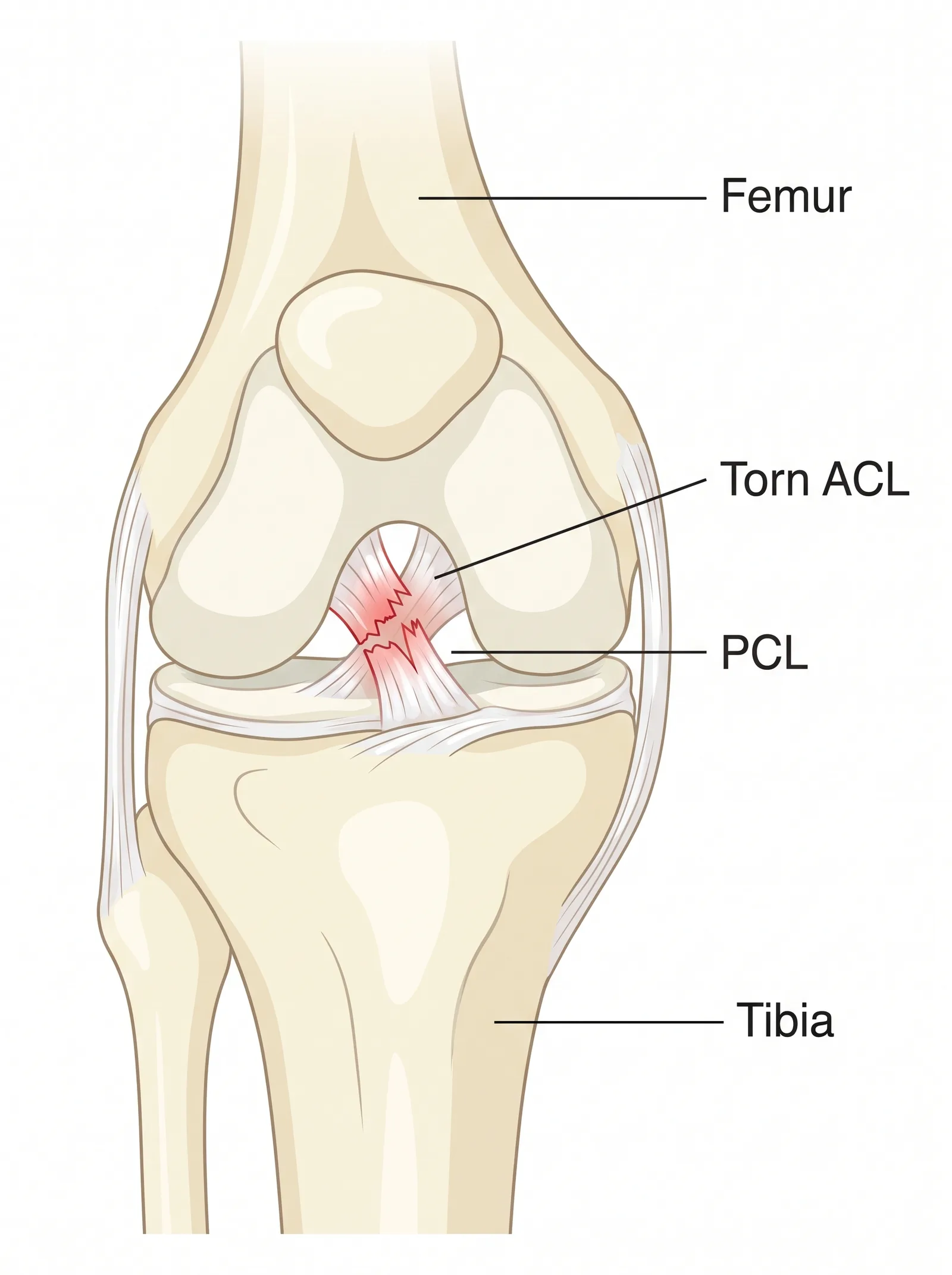
The knee is held together by four main ligaments, which are strong bands connecting bone to bone. They include the anterior and posterior cruciate ligaments in the center and the collateral ligaments on the inner and outer sides. Together they keep the knee steady in every direction.
A hard, high-energy injury, such as a serious fall, a sports collision, or a vehicle crash, can tear two or more of these at once. This is called a multi-ligament knee injury, and in its severe form it can involve the knee coming out of joint, called a knee dislocation. When several ligaments are gone, the knee can be very loose and unstable. Because major blood vessels and nerves run behind the knee, a severe injury like this is treated urgently, and the surgeon checks that these structures are intact. Reconstruction rebuilds the torn ligaments, often more than one in a single operation, to restore stability.
What are the symptoms of Multi-Ligament Knee Reconstruction, and when should you see a specialist?
A multi-ligament injury is usually dramatic and obvious, but not always.
Signs include the following.
- Severe swelling and pain right after a major injury. - A knee that feels very loose or unstable in more than one direction. - Difficulty or inability to bear weight. - A knee that looked out of place at the time of injury, even if it went back on its own. - Numbness, tingling, or a cold or pale foot, which can signal nerve or blood vessel involvement and is an emergency.
Any knee that felt like it came out of joint, or that is very unstable after a major injury, needs urgent evaluation, not a routine appointment. Numbness or a cold, pale foot after such an injury is an emergency and calls for immediate care. Once the knee is stabilized and any urgent issues are handled, a specialist plans the reconstruction. Early evaluation matters here more than in almost any other knee injury.
This page explains the injury and the surgery. It does not tell you what is happening in your own knee. Only an in-person evaluation can do that, and a severe injury needs prompt care.
How is Multi-Ligament Knee Reconstruction diagnosed, and what does the visit involve?
For a severe injury, the first priority is safety: making sure blood flow to the leg and the nerves are intact.
This may involve tests of the blood vessels behind the knee. This is a key reason these injuries are handled promptly.
Once the knee is stable, the surgeon maps exactly which ligaments are torn. The physical exam checks stability in every direction, comparing with the healthy knee. Because several ligaments may be involved, the exam is thorough.
Imaging guides the plan. X-rays check for breaks and joint position. An MRI, a scan that shows soft tissue, shows which ligaments are torn and whether cartilage or the meniscus was hurt. Because the plan depends on the exact combination of injuries, the surgeon studies all of it carefully before deciding the timing and the steps of reconstruction.
What happens during Multi-Ligament Knee Reconstruction, step by step?
Multi-ligament reconstruction rebuilds two or more ligaments, often in one operation.
The sequence below is typical, though these surgeries are individualized.
Anesthesia. Surgery is done under general anesthesia, meaning you are fully asleep, often with a nerve block for pain afterward. Your anesthesia team reviews the plan.
Grafts. The torn ligaments are replaced with grafts, which are pieces of tendon used in place of the ligaments. Because several ligaments may need rebuilding, donor tissue, called allograft, is often used, sometimes along with your own tissue. Your surgeon explains the plan.
Arthroscopy and open steps. Part of the work is done with an arthroscope, a small camera placed through tiny incisions. Some ligaments, especially on the sides of the knee, are rebuilt through open incisions. A multi-ligament surgery usually combines both.
Placing and fixing the grafts. The surgeon drills tunnels in the bone at the natural attachment points and secures each graft, then sets the tension so the knee is stable and can still move. Rebuilding several ligaments in the right order and tension is the core challenge of this surgery.
Final check. The surgeon confirms stability in every direction before closing. These operations take longer than single-ligament surgeries, and a hospital stay is common.
What is the recovery timeline for Multi-Ligament Knee Reconstruction?
Recovery from multi-ligament reconstruction is longer and more careful than from single-ligament surgery, because several repairs must be protected at once.
Progress is measured by what your knee can do. The ranges below are typical and often extended.
Milestone one, protect multiple repairs. Early on, a brace protects the knee, and weight bearing and motion are limited to protect all the grafts. This milestone is about protecting the reconstruction and controlling swelling.
Milestone two, restore motion carefully. Motion is advanced slowly and within safe limits, because moving too fast can stress the repairs. You reach this milestone when you regain the range your therapist sets without forcing it. Stiffness is a known challenge after these surgeries, so motion work is important.
Milestone three, build strength and walk freely. As the repairs heal and your surgeon allows, you move off crutches and rebuild strength. You reach this milestone when you walk without a limp and your surgical leg is regaining strength.
Milestone four, return to activity. Return to sport and demanding activity comes late and only after strength, stability, and confidence return, judged by your surgeon and your tests, not by a date.
According to general guidance from the American Academy of Orthopaedic Surgeons, recovery from complex, multiple-ligament knee reconstruction commonly spans many months to a year or more before return to demanding activity, and timelines vary widely by injury. These are ranges, not promises. Your timeline depends on which ligaments were rebuilt, other injuries, your health, and your rehabilitation.
Read the full guide to preparing for surgery →
Your own recovery instructions come from the office and are specific to you. This page describes the general course, not a plan to follow.
How should you prepare for surgery?
Because recovery is long and early function is limited, planning matters.
Home setup. You will rely on crutches and a brace, so clear walking paths, keep daily items within reach, and set up a comfortable rest spot with the leg supported. A chair with arms helps. Plan for stairs or set up on one level for an extended early period.
Transportation. You cannot drive after anesthesia, and limited weight bearing may keep you from driving for a while. Arrange rides for surgery day and the many early visits.
Time off. Plan significant time away from work, and expect the early phase to be quite limiting. Desk work returns sooner than physical work. Discuss your job with your surgeon.
Who to have available. Arrange help for daily tasks during the early weeks, and have someone with you after you get home. These recoveries lean more heavily on support than most.
Before the day. Follow instructions about eating, drinking, and pausing medicines. Fill prescriptions ahead of time, and set up your rehabilitation plan in advance, since therapy is central to the result.
Which warning signs should you call about?
Some signs after this surgery are urgent because of the severity of the original injury.
Seek emergency care right away for a cold, pale, or numb foot, calf pain with swelling and warmth, which can signal a blood clot, or sudden chest pain or trouble breathing, which can signal a clot that has reached the lungs.
Call the surgical office promptly if you notice:
- Swelling that keeps increasing rather than settling. - Redness spreading around the incisions, or drainage from them. - A fever, which can signal infection. - Pain that worsens or is not controlled by your plan. - A brace that no longer fits or holds as instructed, since it protects several repairs. - New numbness or weakness in the foot or leg.
When unsure, call the office, and if you cannot reach anyone and something feels serious, seek emergency care. Your first call for knee questions is the surgical office at (614) 293-2001 during . Ask what number to use after hours.
What results can you expect from Multi-Ligament Knee Reconstruction?
Many people who have multi-ligament knee reconstruction regain a stable, functional knee after a severe injury, though these are among the more challenging knee surgeries.
Published orthopedic literature reports that outcomes depend heavily on the injury pattern, any nerve or blood vessel involvement, and rehabilitation, and that some stiffness or residual looseness can remain, with results varying by study. According to general guidance from the American Academy of Orthopaedic Surgeons, reconstruction is the accepted approach for restoring stability after multiple ligaments are torn. These are ranges and general statements, not promises.
Your own outlook depends on which ligaments were involved, whether nerves or vessels were injured, other damage in the knee, and your rehabilitation. Your surgeon will give you a realistic picture based on your injury, and insurance questions are answered by the office.
What are the treatment options?
- 01Initial stabilization and protectionThe first step is often protecting the knee in a brace and managing swelling while the urgent concerns, such as blood flow and nerves, are confirmed to be safe. Some parts of the injury may begin to heal during this window.
- 02Physical therapyhas a role before and after surgery, keeping muscles active and the leg as healthy as possible for the reconstruction and recovery.
- 03Selective surgeryNot every torn ligament in every knee is reconstructed. Some injuries are treated with a combination of surgery for certain ligaments and healing for others. The surgeon decides based on which ligaments are torn and how unstable the knee is.
What do patients ask most?
What do patients ask about Multi-Ligament Knee Reconstruction?+
Education and training
Medical school at Ohio State University College of Medicine, Columbus, OH, United States (Doctor of Medicine (MD)). Residency at Henry Ford Health System, Detroit, MI, United States. Fellowship at Henry Ford Health System, Detroit, MI, United States.
- FellowshipHenry Ford Health System, Detroit, MI, United StatesOrthopaedic Surgery, Sports Medicine
- ResidencyHenry Ford Health System, Detroit, MI, United StatesOrthopaedic Surgery
- Medical schoolOhio State University College of Medicine, Columbus, OH, United States (Doctor of Medicine (MD))Doctor of Medicine
- Board statusAmerican Board of Orthopaedic SurgeryBoard certified
The Ohio State University Wexner Medical Center
Jameson Crane Sports Medicine Institute
2835 Fred Taylor Drive
Columbus, OH 43202
Phone(614) 293-2001
The Ohio State University Wexner Medical Center
Orthopedics in Outpatient Care Dublin
6700 University Boulevard
1st Floor, Suite 1B, Dublin, OH 43016
Phone(614) 293-2001
The Ohio State University Wexner Medical Center
Orthopedics in Outpatient Care Lewis Center
6515 Pullman Drive
Suite 1100, Lewis Center, OH 43035
Phone(614) 293-2001